
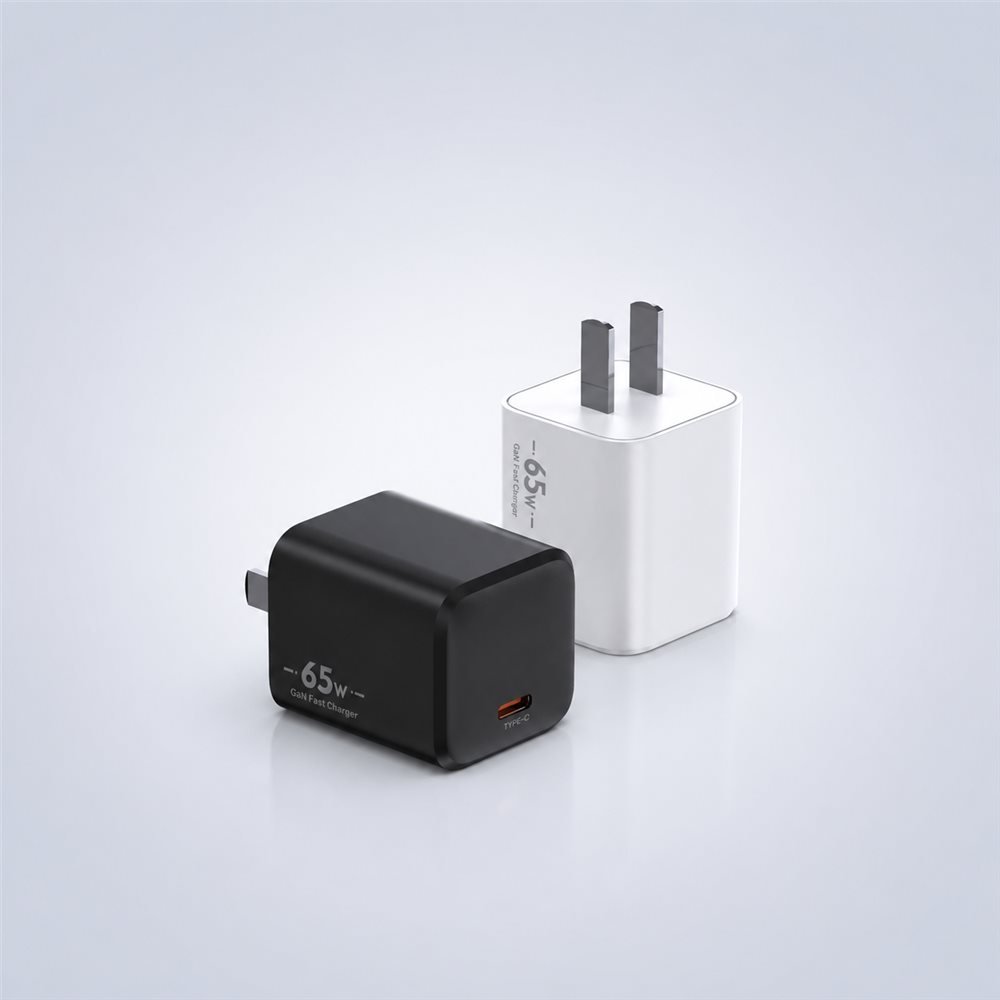
Chargers are one of the best private-label categories on Amazon: repeat demand, universal need, and margins that hold up when you ship a genuinely better product. But 2026 is not 2019 — buyers expect GaN, listings are competitive, and Amazon US now enforces electrical compliance seriously. Get the sourcing right and a private-label GaN charger for Amazon FBA is still one of the fastest, most profitable brands you can launch. This playbook walks through how, from a manufacturer's side of the table.
Why GaN is the only charger worth launching in 2026
Old silicon chargers cannot compete on the search results page anymore. Reviewers, YouTubers and buyers all filter for GaN — smaller housing, cooler operation, higher wattage in the same footprint. If your listing shows a bulky 20W brick next to a competitor's 65W GaN charger the size of an AirPods case, you have already lost. Launching in this category means launching GaN. Everything below assumes that.
Step 1: Pick the right wattage — 65W is the FBA sweet spot
Amazon FBA rewards a focused catalogue over a scattered one. For a first launch, pick one hero SKU and one supporting SKU. From selling data across our OEM customers, the wattages that move on Amazon are:
- 65W GaN charger — the volume seller. Charges MacBook Air, iPad, Android phones and iPhones at full speed. This is your hero product. See our 65W GaN chargers.
- 100W multi-port GaN charger — the "power user" upsell. Two or three USB-C ports, charges laptop plus phone plus watch. Great as a bundle or premium tier. See the 100W GaN charger.
- 140W GaN charger with display — a flagship that stops the scroll. Fewer units, higher margin. See the 140W screen charger.
Skip 20W and 30W to start — they are the most crowded price war on Amazon, and the margin does not survive PPC. 65W and above is where private-label sellers actually make money.
Step 2: Know the certifications Amazon US will demand
Amazon has tightened enforcement on chargers. Before your listing goes live — and definitely before your inventory ships to a fulfilment centre — you need the right paperwork. For the US market:
- FCC — mandatory for any radio-emitting or mains-powered electronic device sold in the US. Amazon can request the FCC ID.
- UL or ETL certification — required for wall-plug chargers under UL 62368-1. Amazon regularly asks for a UL or ETL listing letter, and many state retailers will not stock without it.
- DOE Level VI efficiency — a legal requirement for external power supplies sold in the US.
- Prop 65 label for California listings.
For EU and UK sellers add CE, UKCA and RoHS. For Canada add cULus or ISED. A serious factory will hand you the certificates in your product name at no extra cost — a trader will not. Our buyer's guide to charger certifications and certifications page map every mark to every market.
Step 3: Realistic MOQ for an Amazon FBA launch
You do not need a container to start. For a private-label GaN charger, an honest MOQ from a factory in Dongguan looks like this:
- 500 units per model for OEM branding (logo print, custom colour, custom plug).
- 1,000–2,000 units for custom retail packaging with your artwork.
- 5,000+ units for a fully custom housing or ODM tooling.
For a first FBA launch, 500–1,000 units of a 65W hero SKU is the standard entry point. That is roughly one pallet by air or one LCL shipment by sea — small enough to test, large enough to matter. See our MOQ and lead times guide for the full sampling-to-shipment timeline.
Step 4: Amazon-ready packaging & barcodes
This is where most first-time FBA sellers waste 3–4 weeks. Ask your manufacturer to handle it up front:
- FNSKU labels printed on the retail box (not stickered by you at home). Any real factory will do this.
- Retail-ready packaging that passes Amazon's drop test — usually a corrugated inner box, not a slim sleeve.
- Master carton labels and pallet labels that match your Amazon shipment plan.
- Country of origin marking on both product and carton (US customs requirement).
- UN 3481 lithium-battery marking? — not needed for a bare charger (no battery inside), but keep it in mind if you bundle a cable-plus-charger with a power bank.
A factory that has shipped to Amazon before will already have templates for FNSKU and master carton labels. Ask for a photo of a previous FBA shipment when you inquire — a trader will not have one.
Step 5: Unit cost math & realistic margins
Here is what a private-label 65W GaN charger actually costs to land on Amazon in 2026 — ballpark numbers a first-time seller should plan around:
- Factory FOB unit cost (65W GaN, custom logo, retail box, FNSKU): US$6–9 depending on quantity.
- Sea freight + duty + FBA inbound: US$1.50–3 per unit.
- Amazon FBA fee + referral fee: US$5–7.
- PPC and returns: budget US$3–5.
- Typical retail price: US$29–39.
That is a 30–45% net margin at scale — well above what a reseller of a known brand earns on the same shelf. The reason the numbers work is that you own the brand and the listing, not a distributor above you. See our private-label guide for why this matters.
Step 6: Sample-to-shipment timeline
Plan on 8–12 weeks from first inquiry to Amazon-received inventory:
- Week 1 — inquiry, quote, model selection.
- Week 2–3 — branded samples (logo, colour, retail box mockup).
- Week 3–6 — mass production of 500–1,000 units.
- Week 6–7 — QC, 100% aging and hi-pot testing, FNSKU labelling.
- Week 7–10 — sea freight to US warehouse, or 5–7 days by air for a faster launch.
- Week 10–12 — FBA check-in, listing goes live.
You can compress this to 5–6 weeks if you air-ship, sample in parallel, and pick a model already in stock. If your OEM manufacturer quotes 4 months, something is wrong.
Step 7: Pick a factory, not a trader
The biggest single decision in your FBA launch is who you buy from. A real GaN charger factory can:
- Give you certificates in your product name (a trader cannot).
- Handle Amazon FNSKU labelling and drop-test packaging in-house.
- Ship your reorder in 3–4 weeks instead of 8.
- Use its own GaN chips instead of buying the cheapest available — the difference is fewer returns and better reviews.
Rongjun is a GaN charger factory in Dongguan, China with in-house SMT, aging and hi-pot testing lines. If you want a sourcing sanity check, read how to source GaN chargers from China before you place any order.
Common mistakes Amazon FBA charger sellers make
- Launching 20W instead of 65W — the crowded low-wattage tier is the worst PPC market on Amazon.
- Skipping UL / ETL to save US$1 per unit — then getting the listing suspended.
- Buying from a trader and finding out at reorder that "your factory" was actually a middleman with no capacity.
- Ordering without sampling packaging — and receiving boxes that fail Amazon's drop test at the FC.
- Under-ordering the hero SKU — running out of stock in month 2 kills your Best Seller rank.
Ready to launch your Amazon FBA charger brand? Send us your model and quantity and we will come back within 24 hours with a quote, sample plan and lead time. If you are still comparing suppliers, our wholesale & private-label programme shows exactly how we work with Amazon sellers.