
CE Certified Charger Manufacturer for USB-C GaN Chargers
Rongjun is a CE certified charger manufacturer in Dongguan, China. Every one of our GaN chargers carries CE, FCC and RoHS, most also CCC, PSE and ETL on selected models, and UL test reports, all tested by independent labs. Below you see the real certificates with their report numbers, which model holds which mark, and what each market asks for.
- CE · FCC · RoHS · CCC
- PSE & ETL (selected)
- UL test reports
- Full reports before you order
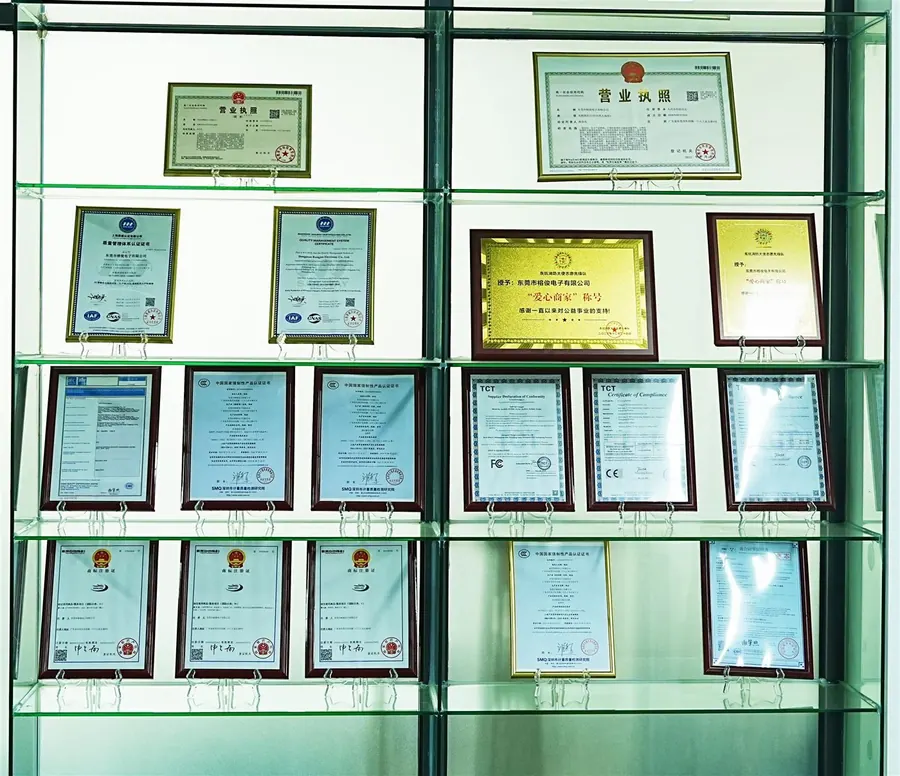
Certificates by Model from a CE Certified Charger Manufacturer
Certificates belong to a model, not to a factory. This is what each charger holds today. Pick the model that already carries the marks for your main market.
| Model | Certificates and reports |
|---|---|
| XPD-V30 30W | CCC · CE (LVD) · FCC · RoHS · UL test report |
| XFC 30W / 35W | CCC · CE-LVD · CE-EMC · FCC · RoHS · UL test report |
| CB 45W Ultra-thin (I and II) | CCC · CE · FCC · RoHS · UL test report |
| XFC 65W | CE · FCC · RoHS · UL test report |
| BK 65W Lipstick | CE · FCC SDoC · RoHS · UL test report |
| CB 65W Ultra-thin (I and II) | CCC · CE-LVD · CE-EMC · FCC · RoHS · UL test report |
| FB 65W | CCC · CE-LVD · CE-EMC · FCC SDoC · RoHS · UL test report |
| HK 65W | CCC · CE · FCC · ETL · PSE · RoHS |
| RJ502 65W with built-in cable | CCC · CE-LVD · CE-EMC · FCC SDoC · PSE · RoHS · UL test report |
| MB 100W | CCC · CE-LVD · CE-EMC · FCC SDoC · RoHS · UL test report |
| ZC504 140W with display | CE · FCC · RoHS · UL test report |
All models: USB-C Power Delivery, flame-retardant V-0 PC housing, 100% aging and hi-pot test. See all models and specs →
Our CE, FCC and RoHS Certificates: the Real Documents
Every document names Dongguan Rongjun Electronic as applicant and manufacturer, lists the model numbers it covers and carries a report number you can check with the lab. Tap a certificate to enlarge it.
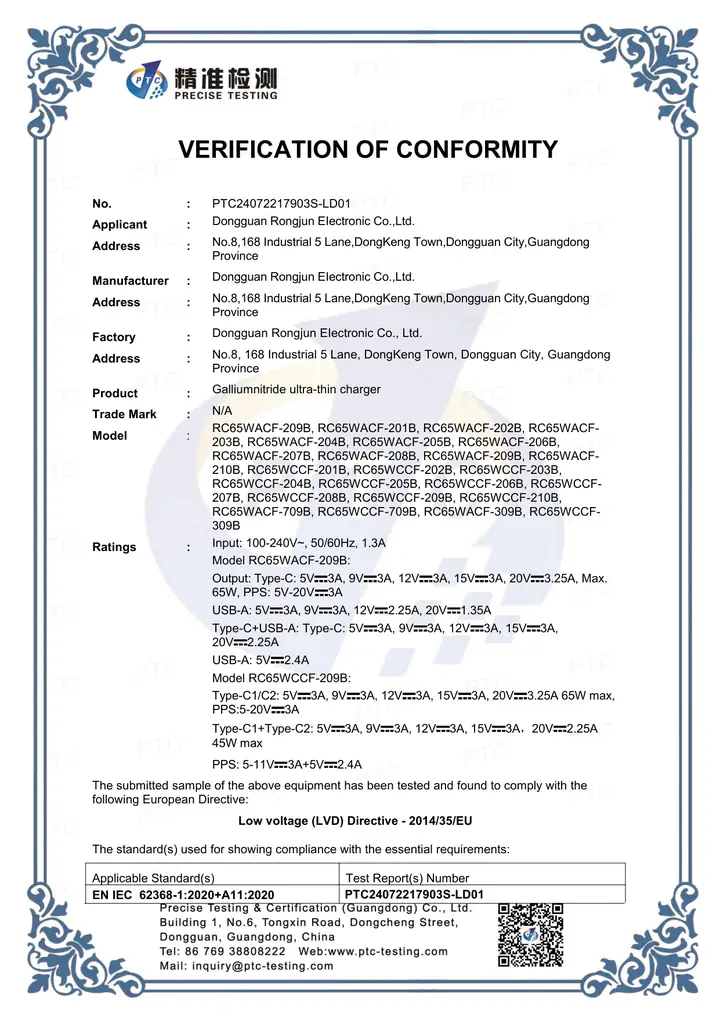 Tap to enlarge
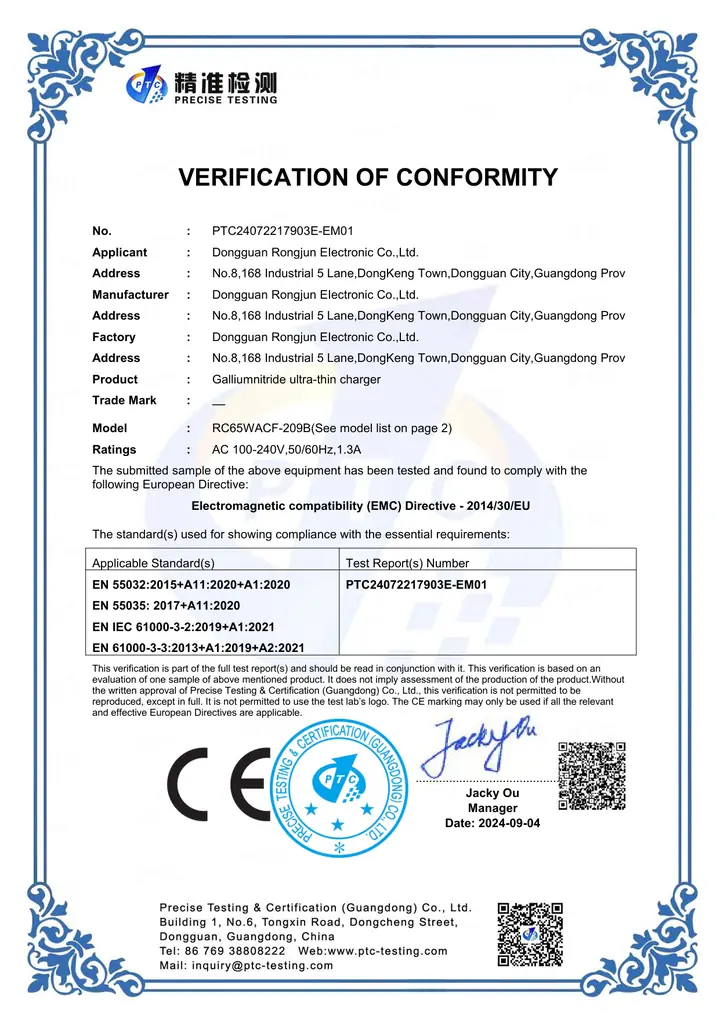 Tap to enlarge
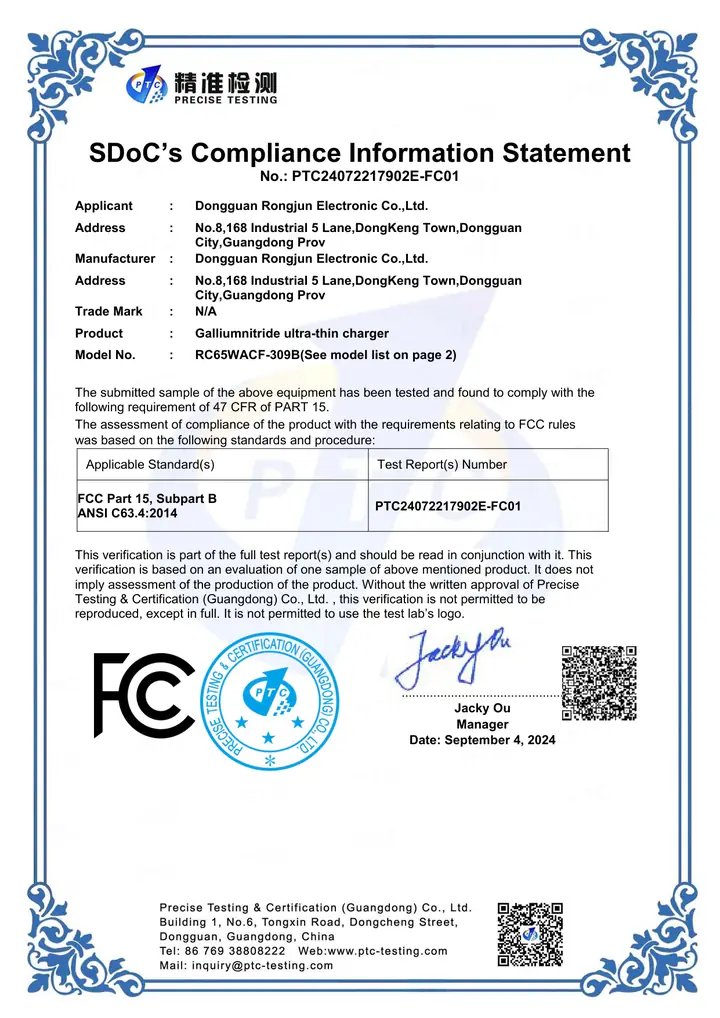 Tap to enlarge
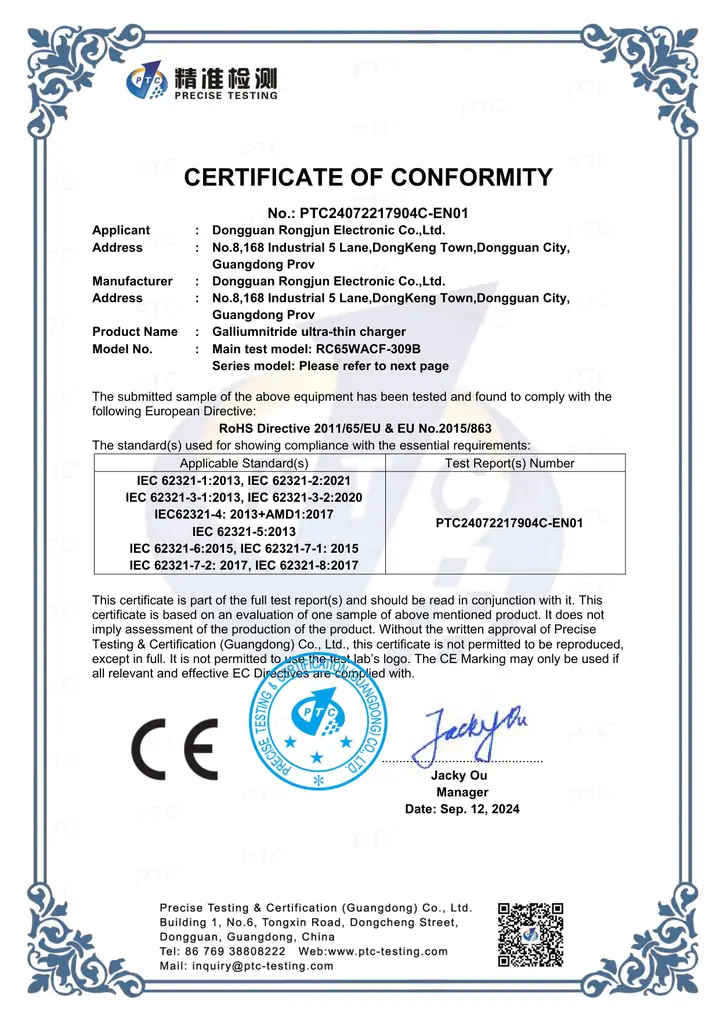 Tap to enlarge
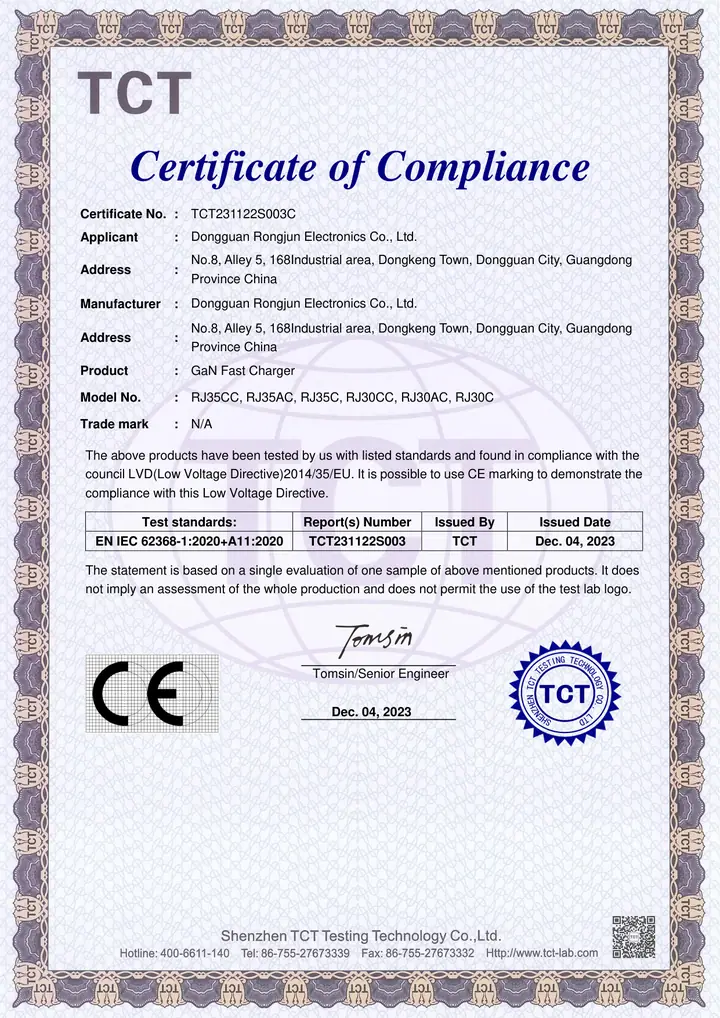 Tap to enlarge
Each certificate belongs to a full test report (for example 93 pages for the CE-LVD report of the CB 65W). We send the complete reports for your model by email.
What a CE Certified Charger Must Pass
A CE certified charger meets three sets of EU rules. CE marking is the manufacturer's own declaration, so the proof is in the test reports behind it. These are the standards our CB 65W ultra-thin charger was tested to:
| Part of CE | What it checks | Standard | Our report no. |
|---|---|---|---|
| Low Voltage Directive 2014/35/EU (LVD) | Electrical safety: shock, fire, heat and insulation | EN IEC 62368-1:2020+A11:2020 | PTC24072217903S-LD01 |
| EMC Directive 2014/30/EU | Interference with other devices, and resistance to it | EN 55032, EN 55035, EN IEC 61000-3-2, EN 61000-3-3 | PTC24072217903E-EM01 |
| RoHS 2011/65/EU and (EU) 2015/863 | Lead, mercury, cadmium and other restricted substances | IEC 62321 test methods | PTC24072217904C-EN01 |
EU common charger rule. Since 28 December 2024, phones, tablets, cameras and other small devices sold in the EU must charge over USB-C, and laptops followed on 28 April 2026. All our chargers are USB-C Power Delivery chargers, so they fit this rule.
REACH compliance. Beyond RoHS, the EU REACH regulation requires manufacturers to declare any Substance of Very High Concern (SVHC) above 0.1 % by weight. The SVHC candidate list is updated twice a year. Ask us about REACH for the model you plan to import.
How a Charger Gets CE Certified: Step by Step
CE marking is the manufacturer's own declaration, but a credible declaration needs independent lab reports behind it. This is the process our chargers go through:
Sample submission
Production-intent samples go to an accredited lab (our reports come from PTC and TCT). The lab needs the charger, its power cable and the technical file (schematics, BOM, PCB layout).
Safety testing (LVD)
The lab runs the full EN IEC 62368-1 test programme: insulation resistance, leakage current below 0.5 mA, temperature rise at full load (surface below 85 °C), abnormal-condition tests and drop/impact. A 65 W GaN charger report typically runs 50 to 100 pages.
EMC testing
A second set of tests measures conducted and radiated emissions (EN 55032, Class B for residential use) and immunity to surges, ESD and radio interference (EN 55035). The charger must not disturb other electronics and must keep working near them.
RoHS material analysis
Component samples go through XRF screening and, where needed, wet-chemistry analysis for lead, mercury, cadmium, hexavalent chromium and restricted phthalates under IEC 62321.
Report and DoC
The lab issues the test reports and a Verification of Conformity. The manufacturer or EU importer then signs the Declaration of Conformity (DoC), and the CE mark goes on the housing, the label and the packaging.
Importers can request the full test reports for their model before placing an order — see the real certificate front pages in the documents section above.
How Long Does CE Certification Take for a Charger?
Timing depends on the lab queue, the number of models and whether the design passes on the first round. For a single GaN charger model with no design changes needed:
| Stage | Typical time | What can slow it down |
|---|---|---|
| Sample preparation and technical file | 1 – 2 weeks | Incomplete schematics or BOM |
| LVD safety testing (EN IEC 62368-1) | 3 – 4 weeks | Test failure → redesign → retest |
| EMC testing (EN 55032 / 55035) | 2 – 3 weeks | Conducted emissions above Class B limit |
| RoHS material analysis | 1 – 2 weeks | Wet-chemistry follow-up on flagged components |
| Report review and DoC signing | 1 week | — |
| Total (first-pass) | 6 – 10 weeks | Add 3 – 6 weeks if a retest is needed |
Our standard models are already certified, so you do not wait for testing. For an OEM project with a new model number, ask us early which tests and how much time your market needs.
Does a GaN Charger Need Different Certification Than Silicon?
No. GaN and silicon chargers are tested to the same safety and EMC standards. The lab does not care which semiconductor is on the primary side — it cares about what comes out: voltage, current, temperature, leakage and emissions. But GaN does change the test results in practice:
| Test area | GaN advantage | Why it matters for certification |
|---|---|---|
| Temperature rise | 10 – 15 °C lower surface temp at same wattage | More margin under the 85 °C limit in EN IEC 62368-1 |
| Efficiency (DoE / CoC) | 92 – 95 % vs 85 – 88 % for silicon | Easier to meet EU Code of Conduct on energy efficiency |
| EMC emissions | Higher switching frequency can increase conducted emissions | GaN designs need careful filtering; our models pass EN 55032 Class B |
| Size and insulation | Smaller board, tighter clearances | Creepage and clearance distances must still meet IEC 62368-1 minimums |
In short, GaN makes the thermal and efficiency tests easier to pass but demands tighter EMC filtering and careful PCB layout. All our GaN chargers have passed both safety and EMC testing — the report numbers are in the documents section and the product pages.
Common CE Test Failures in Charger Certification
Not every charger passes on the first round. These are common reasons chargers fail CE testing, and what a sound design does to avoid them:
| Failure | What happens | How a good design avoids it |
|---|---|---|
| Conducted emissions above Class B | The charger injects noise back into the mains wiring. Common in high-frequency GaN designs. | Multi-stage EMI filter on the input: X-cap, Y-caps and common-mode choke tuned to the switching frequency. |
| Creepage / clearance too short | The gap between high-voltage and low-voltage traces is below the IEC 62368-1 minimum. Compact GaN boards are tight. | Check the PCB layout against the standard's distance tables before the first prototype; slots in the board can add creepage distance. |
| Surface temperature above 85 °C | The housing gets too hot at full load, which fails the temperature rise test. | GaN runs cooler than silicon at the same wattage; good heat spreading inside the housing adds margin. |
| Leakage current above 0.5 mA | Touch current between the output and earth exceeds the limit, usually caused by Y-cap values that are too high. | Choose Y-capacitor values with margin below the limit. Our 100% hi-pot test checks the insulation of every unit. |
| Abnormal-condition failure | The charger catches fire or produces excessive heat when a component is shorted deliberately. | Flame-retardant V-0 PC housing, multiple fuses on the primary side and thermal shutdown on the controller IC. |
A failure usually means a redesign, a retest fee and extra weeks. That is why it pays to buy a model that already holds the reports for your market.
FCC, UL Test Report, ETL and PSE Explained
- FCC (USA): required for electronics sold in the US. Our models carry an FCC SDoC to FCC Part 15, Subpart B, backed by a lab report.
- UL test report: most models have a safety test report to UL/IEC 62368-1 from an independent lab. A UL test report is not a UL Listing, and we never call our chargers "UL listed". Many importers use the report for their own compliance file.
- ETL listing (HK 65W): an Intertek listing for the US and Canadian markets. If your retailer asks for a listed charger, start with the HK 65W.
- PSE (Japan): required for AC chargers sold in Japan. The HK 65W and the RJ502 65W hold PSE, so we are a PSE charger manufacturer for those two models.
- CB Scheme report: an international IEC 62368-1 report that helps you get other national marks. We do not hold one on our standard models, but we can arrange a CB report for OEM projects.
USB Charger Certifications by Country
What a charger needs in each market, and what we can supply today.
| Market | What a charger needs | Rongjun today |
|---|---|---|
| European Union | CE (LVD + EMC) and RoHS, USB-C under the common charger rule | ✓ All models |
| United Kingdom | CE marking is accepted in Great Britain for chargers; UK plug | ✓ CE reports, UK plug or adapter |
| United States | FCC; retailers often ask for a safety report or a UL/ETL listing | ✓ FCC + UL test report; ETL on HK 65W |
| Canada | EMC compliance and a safety listing such as cETL or cUL | ✓ HK 65W (ETL) |
| Japan | PSE | ✓ HK 65W, RJ502 |
| China | CCC (compulsory) | ✓ Most models |
| Australia / New Zealand | RCM | Not held today, ask us |
| South Korea, India, Saudi Arabia | KC, BIS, SASO | Not held today, ask us |
Rules change; your importer or customs broker should confirm the current requirements for your market. Plugs: US, UK, EU, CN and AU options per model.
How to Check a Charger Supplier's Certificates
A CE or FCC logo on a datasheet proves nothing. Check these six points on any supplier's documents, including ours:
Model number
The certificate lists the exact model you buy, as main or covered model.
Applicant name
The applicant or manufacturer is the factory you deal with, not a third company.
Report number
Every certificate refers to a full test report. Ask for it and check it with the lab.
Current standard
Safety should be tested to EN IEC 62368-1, which replaced EN 60950-1.
- Real CE mark: the C and E are spaced apart. A cramped "CE" can be the look-alike "China Export" mark.
- Production testing: certificates test one sample. Ask how every unit is tested; we run a 100% aging test and a 100% hi-pot test.
What Is in a Charger's EU Declaration of Conformity
The Declaration of Conformity (DoC) is the legal document behind the CE mark. An importer in the EU should have a copy on file for every product. A valid DoC for a USB-C charger contains:
- Manufacturer name and address — must match the company you are buying from. On our test reports the applicant and manufacturer is "Dongguan Rongjun Electronic Co., Ltd." with our Dongguan address.
- Product identification — model number, trade name and any variant numbers the declaration covers.
- EU directives — the DoC must list each directive the product falls under: LVD 2014/35/EU, EMC 2014/30/EU, RoHS 2011/65/EU and, where applicable, the Ecodesign or Radio Equipment Directive.
- Harmonised standards — the specific standard editions used in testing, for example EN IEC 62368-1:2020+A11:2020, EN 55032:2015+A1:2020.
- Test report references — report numbers linking back to the lab files. This is how customs or a market surveillance authority checks the claim.
- Signature, date and place — signed by an authorised person at the manufacturer, with the date and city.
If you are the importer of record in the EU, you keep the DoC and the test reports on file, and your name and address go on the product or packaging. Ask us for the reports for your model.
Safety and Quality Behind the Certificates
- Protection on every board: over-voltage, over-current, over-temperature, short-circuit and surge protection.
- Flame-retardant V-0 PC housings.
- Incoming inspection of components and GaN chips before production.
- 100% aging test under load and 100% hi-pot insulation test.
- Final QC of output, ports and finish before packing. Your own inspector (SGS or others) is welcome.
Building your own brand? See private label chargers and OEM / ODM.
 Watch: inside our factory (29 s)
Charger Certification Questions
Are your chargers CE certified?
Is CE marking a third-party certificate?
Are your chargers UL listed?
Do you have a CB Scheme report?
Which chargers can I sell in Japan?
Can I see the full certificates before I order?
Do I need UKCA to sell chargers in the UK?
Do GaN chargers need different certification?
How long does CE certification take for a charger?
What is the difference between CE marking and CE certification?
What does REACH mean for charger imports?
Can I use your CE test reports for my own import declaration?
Get the test reports for your market
Tell us the model and where you sell. We reply within 24 hours and send the certificates and test reports for your model.
Request the full document by email