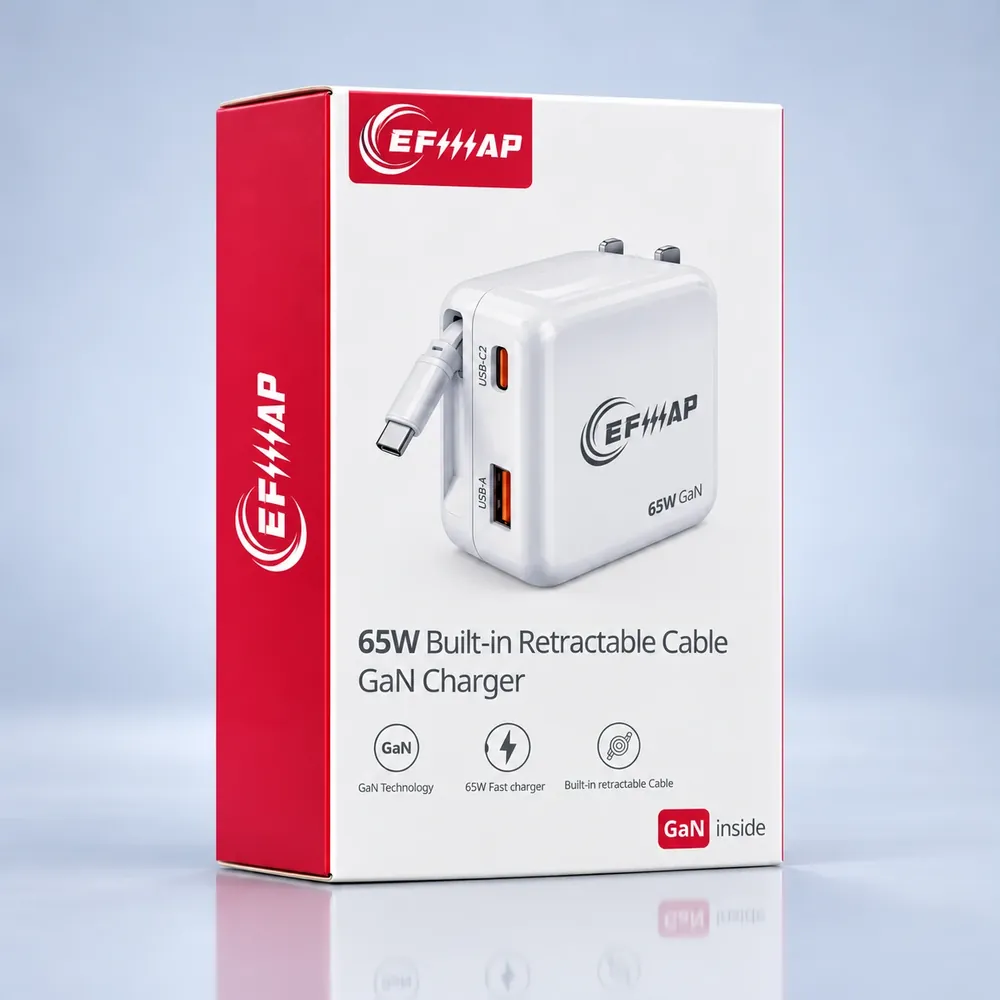
How to Design a Custom Charger
A guide for brands, not engineers: what to put in the brief, the decisions that drive cost and time, and how a factory takes a charger from idea to production.
Search for how to design a custom charger and most results are battery-charger circuits for engineers, or tips for decorating a cable. If you run a brand and want a USB-C wall charger that's yours, from the shape to the power settings, the process looks quite different. You don't design the circuit. You decide what the charger has to be, and a factory designs and builds it.
I'm Chen Jun Liang, and I lead R&D at Rongjun in Dongguan. In more than ten years in charger R&D, I've worked on more than 300 OEM projects. This is the process we follow when a brand asks us for a new charger, and the places where projects most often lose time.
First: do you need a new design?
Before anything else, be honest about this. A new design, which factories call ODM, means a new mould, new engineering and new certification. With us it starts at 5,000 pieces. Many brands are better served by an existing, tested model with their logo, colour and box, which starts at 500 pieces and has no tooling cost.
| You want | Usually the right route |
|---|---|
| Your logo and colours on a good charger | Existing model, from 500 pcs |
| A unique shape or size | New design (ODM) |
| A port layout or wattage we don't make | New design (ODM) |
| A charger tuned to one device's power profile | New design, or settings on an existing model; ask us |
| A product nobody else can sell | New design (ODM) |
If the existing route fits, our private label vs white label guide explains the options. If you need something new, read on.
Step 1: write the brief
A good brief saves weeks. It doesn't need to be technical, but it does need to be specific. Include:
- Power and ports. Total wattage, number of USB-C and USB-A ports, and how power should be shared when several devices are plugged in.
- Devices it must charge. The phones, tablets and laptops your customers use. This decides the charging profiles.
- Plug. US, EU, UK or AU; fixed or foldable pins; or interchangeable plug heads for several markets.
- Size and look. Maximum dimensions, shape references, colours and surface finish.
- Markets and certifications. Where you'll sell, so the design can meet those rules from the start.
- Price and volume. Target unit price, first order quantity and expected yearly volume.
Price and volume matter more than most brands expect. A brief that asks for 140 W in a tiny housing at the price of a 30 W charger will need to change somewhere, and it's better to find that out at the start.
Step 2: NDA and feasibility
We sign an NDA before discussing an ODM project. Then our engineers check the brief against what's physically possible: can this power fit in this size without overheating, will the parts fit, and can the target price work at that volume. You get back a proposal with what we'd change, if anything, and a quotation.
This is also the time to agree in writing who owns what: the housing design, the mould and any registered design rights. Don't leave it until after the samples.
A shortcut worth asking about: our ODM design catalogue has partly developed designs that can be adapted. Starting from one of those is often quicker than a blank page, because some of the engineering is already done.
Step 3: industrial design
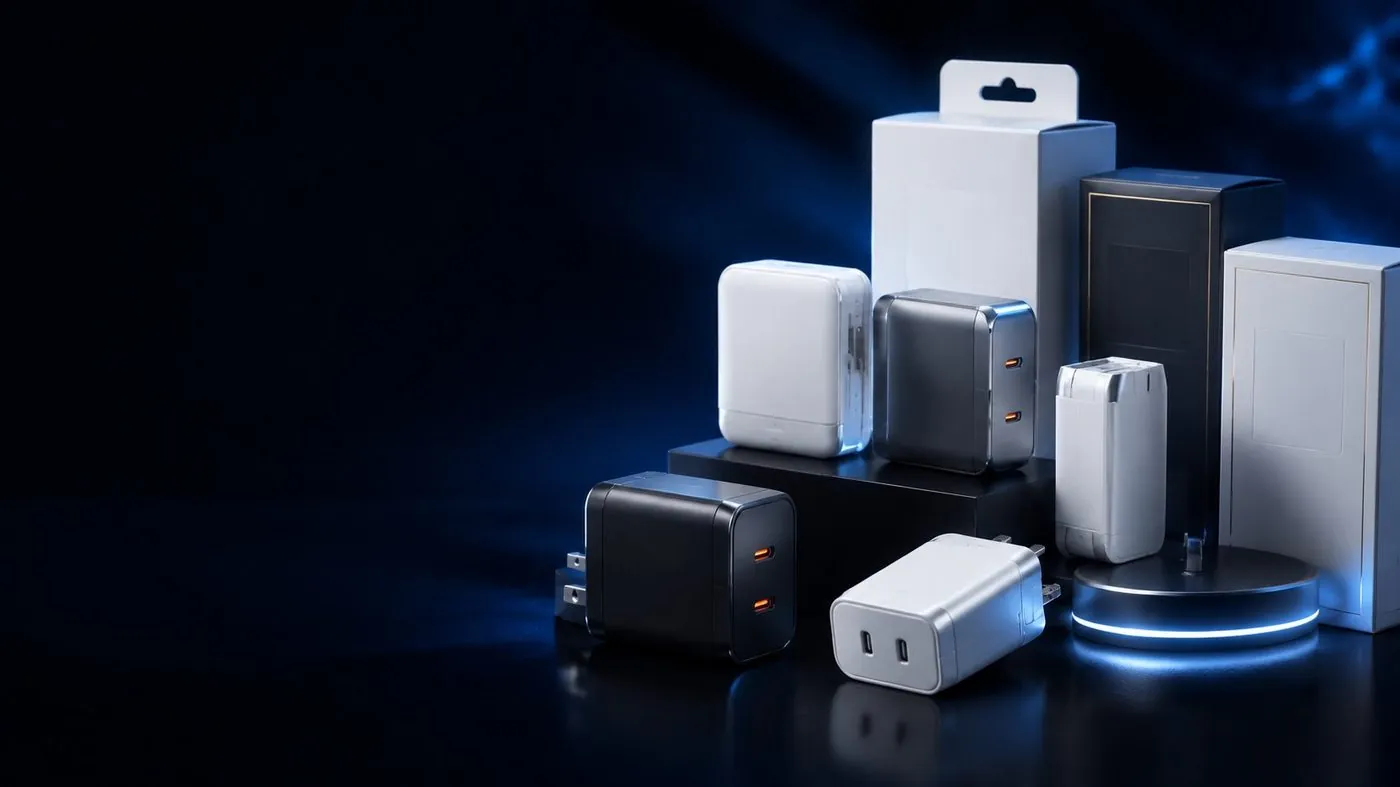
The industrial design sets the shape, the size, the position of the ports and the look. You'll usually see renders first, then a 3D-printed model you can hold. Check it in your hand, plugged into a real socket, next to the devices it will charge.
Things to look at closely:
- whether it blocks the next socket on a power strip;
- how the ports are spaced when two thick cables are plugged in;
- where your logo and the rating label will go, and whether the required markings fit;
- for foldable pins, how easily they open and how firmly they lock.
Two of our own housing designs are registered design patents in China (CN 308679717 S and CN 308510839 S). If the look of your charger matters to your brand, ask whether registering its design makes sense in your markets.
Step 4: electronics and charging profiles
This is the factory's job, but you should understand the choices because they affect how the charger behaves for your customers.
- GaN or silicon. GaN parts let a charger deliver more power in a smaller size. We make silicon chargers too, on customer demand. See GaN vs silicon.
- Charging protocols. USB Power Delivery is essential. PPS matters for phones that use it for their fastest charging. See PD vs PPS.
- Power sharing. On a multi-port charger, how the total power is split when two or three devices charge at once. This needs to be written down and tested.
- Protection. Over-voltage, over-current, over-temperature and short-circuit protection are standard, and safety testing checks them.
The power-sharing table is the detail most often left vague in a brief, and the one customers notice first. Ask for it in writing and check it on the samples.
Step 5: the mould
Once the design is frozen, the injection-moulding tools are made. This is the point where changes become expensive, because altering the shape means altering the steel. Make sure everyone has signed off the industrial design before the mould is cut.
The mould is also why a new design needs a larger order. Its cost has to be spread over enough chargers to make sense, which is why our ODM minimum is 5,000 pieces.
Step 6: samples and testing
The first samples from the real mould and real electronics are the most important step in the project. Expect at least one round of changes. Test them as your customers will:
- Charge every device on your list, alone and together, with a USB power meter showing the voltage and current.
- Check the power sharing matches the agreed table.
- Charge a laptop at full power for a long session and feel how warm the housing gets.
- Check the finish, colour, logo, port fit and pin action.
- Check the label and markings against your market's rules.
At our end, the samples go through our engineering tests before they reach you. Our charger quality inspection guide lists the checks in more detail.
Step 7: certification
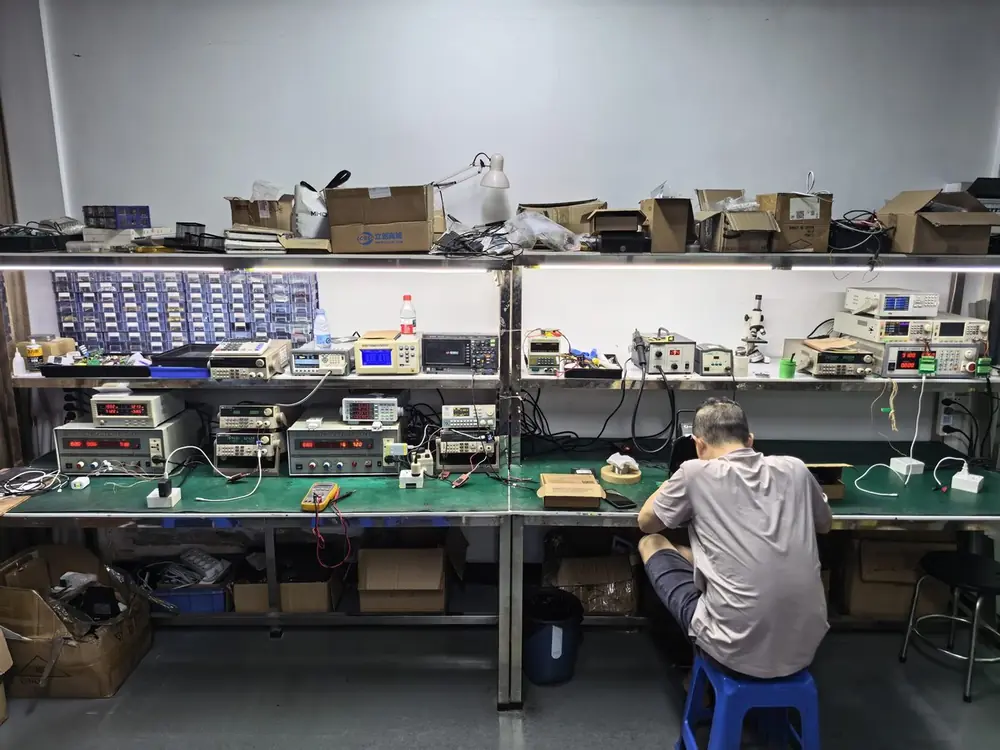
A new design needs its own safety and EMC testing for each market, because test reports apply to a specific model. Testing is done on final samples, so plan it after the design is frozen and before mass production.
- Europe and UK: CE under the Low Voltage and EMC directives, RoHS and the efficiency rules. See certifications for Europe.
- United States: FCC Part 15, DOE efficiency, and usually UL or ETL listing for retail. See US requirements.
Remember that the brand placing the charger on the market has its own legal duties, such as the Declaration of Conformity in Europe. The factory supplies the reports; the declaration is yours.
Step 8: pilot run and production
Before full production, a small pilot run checks that the design can be built consistently on the production line, not just by engineers. Problems found here, in assembly, testing or packing, are fixed before thousands of units are made.
Then production runs like any other order: every charger is hi-pot and aging tested, any unit that fails is repaired and retested on the spot, outgoing inspection uses AQL 0, 0.65 and 1.5, and you get the report with the shipment. Our chargers carry a 24-month warranty.
Design for the 2028 EU rules
If your new charger will still be on sale in the EU after 14 December 2028, design it for Regulation (EU) 2025/2052 now. According to the European Commission, common chargers will need at least one USB-C port, work only with detachable cables, be marked with the power at each port and carry a new EU common charger logo. Markings are part of the housing, so they belong in the industrial design, not added later. Our EU common charger guide explains the rules.
Where custom charger projects lose time
- A vague brief. "Fast and small" means different things to different people. Numbers avoid that.
- Changing the design after the mould. Every change to the shape means changing the tool.
- Testing samples on one phone. Test every device your customers use, together.
- Leaving certification to the end. Plan the markets and labels at the brief stage.
- Unclear ownership. Agree who owns the design and the mould before work starts.
 Inside our charger factory: from SMT to packing
FAQ: how to design a custom charger
How do I design a custom charger?
Do I need to be an engineer to design a charger?
What is the minimum order for a custom charger design?
How much does it cost to design a custom charger?
How long does it take to design a custom charger?
Who owns the design of a custom charger?
Can you design a charger to match my existing product?
What should a custom charger brief include?
Have a charger idea?
Send us your brief, even a rough one. We'll sign an NDA, tell you honestly what's possible, and send our ODM design catalogue.
Get a quote