How to Import Chargers from China
A step-by-step guide for UK and EU buyers, written for chargers rather than goods in general: the commodity code, what you'll pay at the border, the marks the charger and box need, and how the order moves from our line to your warehouse.
The first order is the hard one. After that, importing chargers becomes a routine you repeat every few months. The good news is that chargers are one of the simpler things to bring in from China: they're small, light, they don't contain batteries, and in the UK the usual commodity code carries no customs duty at all.
Most guides on this subject are written by freight forwarders and VAT agents, and they're useful, but they cover "goods" in general. I'm going to stick to chargers. We make them at Rongjun in Dongguan and ship them to importers in the UK, Europe, the Gulf and Africa, so this is the process as it actually runs on our side and on yours.
Three things to set up first
An EORI number
You need one to import commercially. In Great Britain it starts with GB and comes from HMRC; in the EU you get it from the customs authority of your member state. It's free. Barrington Freight's guide lists it as an early step for a good reason: without it, your forwarder can't clear the goods and they sit at the port.
VAT registration (if you can)
Import VAT is usually the biggest number on a charger import. If you're VAT-registered you can reclaim it; if you're not, it's a straight cost. Epic Sourcing's UK duty guide makes the point well: on a few thousand pounds of stock, the reclaimable VAT can be more than a thousand pounds.
A responsible person in your market
Under the EU General Product Safety Regulation, consumer products need a named economic operator in the EU, with contact details on the product, the packaging or an accompanying document. A factory in China can't be that person. If you're the importer, it's usually you. Tell us the name and address and we print it on the box or label.
How to import chargers from China, step by step
| Step | Who | Typical time |
|---|---|---|
| 1. Choose the model, plug type, quantity and packaging | You | A few days |
| 2. Check the supplier is a real factory and see its test reports | You | 1–2 days |
| 3. Order a sample with your logo | Factory | Ready in 3 days, plus courier |
| 4. Approve the sample and sign the proforma invoice | You and factory | 1–2 days |
| 5. Pay the 50% deposit | You | 1–3 days for the transfer |
| 6. Production | Factory | 10–15 days for 1,000 pcs, 15–20 days for 3,000 |
| 7. Final inspection, then the 50% balance | Factory or your inspector | 1–2 days |
| 8. Freight, customs clearance and delivery | Your forwarder | Days by air, weeks by sea or rail |
A few notes on the steps that cause the most trouble.
Step 2. Ask for the first page of the CE test report for the exact model and check whose name is on it. If it isn't the company you're buying from, someone else makes the charger. Our factory vs trading company guide covers the other checks.
Step 3. Test the sample on the devices your customers actually use: the phones, the laptops, the cables. We send one free sample per model, up to two models, with your logo if you want it. You pay the courier.
Step 4. SimplyVAT's guide puts it bluntly: you get exactly what you ask for, and anything you leave out, the factory fills in with its best guess. For a charger that means writing down the model, port layout, plug type, colour, logo position, packaging and quantity per line. All of it goes on the proforma invoice.
Step 7. Book the inspection before you pay the balance. More on that below.

Commodity code, duty and VAT
Everything at the border hangs off the commodity code. Mains chargers for phones and laptops sit under heading 8504 40, "static converters". On the UK Trade Tariff, we checked 8504 40 95 90 on 12 October 2026: the third-country duty was 0%.
Two cautions. First, codes and rates change, and the code depends on the exact product, so ask your forwarder to confirm it before the goods ship. Epic Sourcing also suggests an advance ruling from HMRC if you import a lot; it gives you certainty on the classification. Second, a charger with a built-in battery isn't the same product for customs or for shipping, so don't reuse the code for a power bank.
A worked UK example
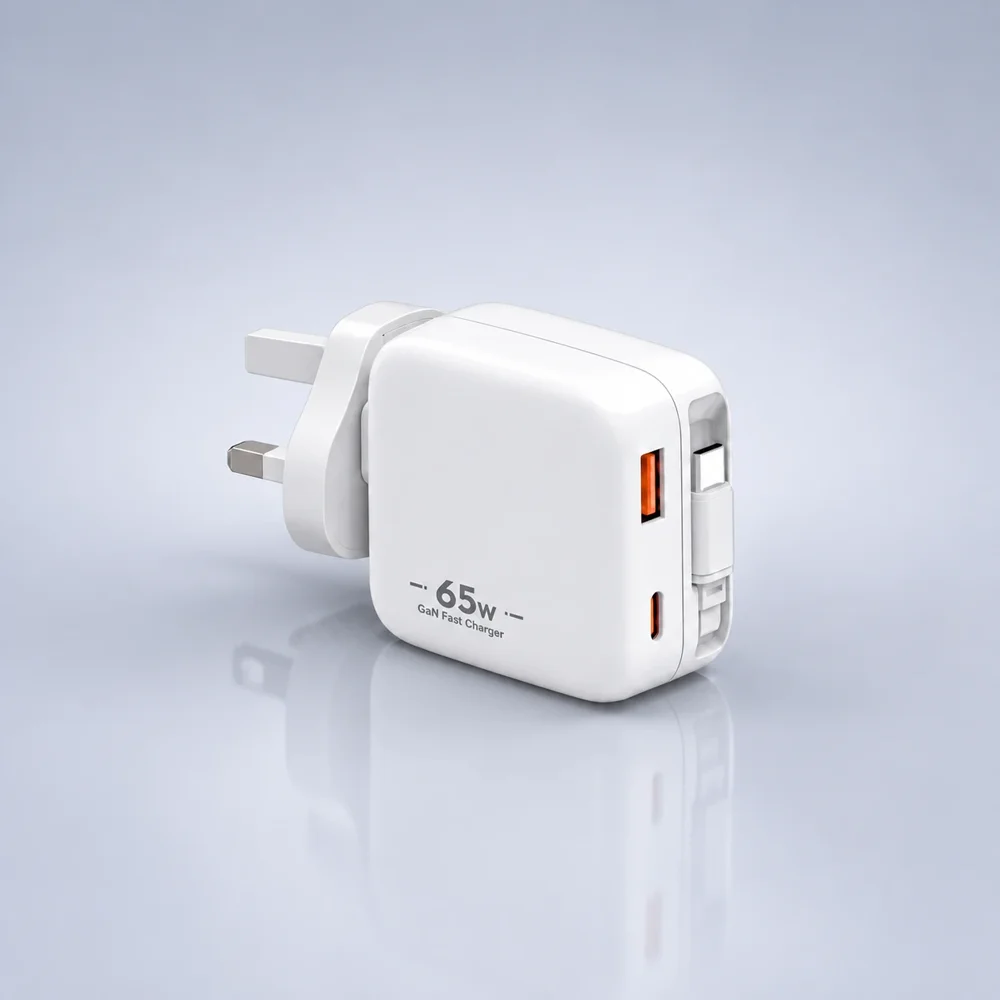
Take 1,000 of our XFC 65W chargers with a UK plug. The goods are about US$5.08 to 5.69 a piece depending on quantity and plug. The freight and clearance figures below are only example numbers; your forwarder will quote the real ones.
| Line | Example |
|---|---|
| Goods (1,000 pcs, converted to pounds) | about £4,200 |
| Sea freight and insurance to a UK port (example) | £800 |
| Customs value (goods + freight + insurance) | £5,000 |
| Customs duty at 0% | £0 |
| Import VAT at 20% of £5,000 | £1,000 (reclaimable if VAT-registered) |
| Clearance and delivery (example) | £250 |
For a VAT-registered business, the landed cost in this example is about £5,250, or £5.25 a charger, before your own storage and selling costs. SimplyVAT explains the customs value well: it's what you paid for the goods plus the transport to the border, and VAT is charged on that value plus any duty.
The EU and the US
In the EU, check the rate for your code in the TARIC database. Import VAT is charged at the rate of the country where the goods are cleared, for example 19% in Germany and 21% in the Netherlands. For the US, check the current tariff situation with your customs broker before you order; rates on Chinese goods have changed often and quickly, and we'd rather you got the current number from them than an old one from us.
What has to be on the charger and the box
This is where first imports get held up. SimplyVAT says it clearly: EU rules don't apply to a factory in China. The importer is the one who has to make sure the product is compliant. Here's what that means for a USB-C wall charger.
| Requirement | What it is | Who provides it |
|---|---|---|
| CE marking | Safety (EN IEC 62368-1) and EMC tests behind the mark | Factory: test reports and the mark on the charger |
| Declaration of Conformity | Signed statement listing the rules and standards | The manufacturer or importer, based on the test reports |
| RoHS | Limits on lead, mercury and other substances | Factory: RoHS test report |
| Responsible person (GPSR, EU) | Named operator in the EU with contact details | You; we print it on the box |
| WEEE and packaging rules | Producer registration in each country you sell in | You register; we print the marks and numbers |
| UKCA (Great Britain) | Optional for chargers while CE is recognised | Not required if CE is valid |
A word on UKCA, because guides disagree. Epic Sourcing's article says UKCA is needed for electronics. The UK government has since extended recognition of CE marking for most product rules, including electrical safety and EMC, so a correctly CE-marked charger can be sold in Great Britain. If a buyer asks for UKCA anyway, that's a commercial choice, not a legal one. Our European certifications guide goes through each item in detail, and our test reports are on the certifications page.
Sea, rail or air
Chargers are compact, so most first orders don't fill a container. They travel as LCL (less than container load), sharing a box with other importers' goods. Barrington Freight recommends LCL for exactly this situation: testing a market with a small first order.
| Mode | Typical transit (as quoted by forwarders) | Best for |
|---|---|---|
| Sea (LCL or FCL) | Up to about 6 weeks door to door to the UK; about 30–32 days to most EU ports | Full orders, lowest cost per piece |
| Rail | Up to about 17 days to Europe | Mid-size orders that can't wait for sea |
| Air | About a week | Samples, urgent top-ups |
Sources: Barrington Freight (UK) and SimplyVAT (EU). Transit depends on route, season and carrier.
One advantage chargers have over many electronics: a mains charger without a built-in battery isn't dangerous goods, so it can fly as normal cargo. Power banks are a different story. Barrington also notes that sea freight is charged on weight or volume, whichever is greater, and for chargers it's almost always volume. Retail boxes take up much more space than chargers packed in strips, so packaging choice changes your freight bill.
EXW, FOB and why we don't sell DDP
We quote EXW (you collect from our factory) or FOB (we deliver to the port and clear Chinese export). Barrington Freight's advice is the same as ours for most UK buyers: FOB, with your own forwarder from the Chinese port onwards.
Epic Sourcing suggests asking for DDP quotes so you can compare an all-in landed price. We see why, but we don't sell DDP. With DDP, someone else declares the value of your goods at your border, and you don't see what they declared. If a cheap DDP price depends on a low declared value, the problem doesn't disappear; it lands on the importer later. With FOB, the declaration is made in your name, at the real value, by a forwarder you chose. Our DDP vs FOB guide explains it in more detail.
Checks before the goods leave
Problems are cheap to fix in the factory and expensive to fix in your warehouse. On our side, every charger gets a hi-pot test and an aging test under load. A unit that fails is repaired and tested again on the spot. Final inspection uses AQL with zero accepted critical defects, 0.65 for major and 1.5 for minor, and an inspection report goes with every order.

You can add a third-party inspection on top. Book it for the days just before the balance is due, so that if something is wrong you still have the payment as leverage. We welcome inspectors. Our charger quality inspection guide explains what an inspector checks.
Timing around Chinese New Year
Chinese New Year 2027 falls on 6 February. Factories across China close for the holiday, and many lose staff who don't come back afterwards, so capacity is tight for several weeks either side. If you need stock in February or March, place the order and pay the deposit by early December. The same goes, to a lesser degree, for the October Golden Week.
Peak season matters too. Brands build Christmas stock in late summer and autumn, and both factories and freight get busy. A first order placed in a quiet month moves faster and is easier to fit into the production schedule.
Costs people forget
- Origin charges at the Chinese port, if you buy EXW.
- Clearance fees from your forwarder or broker.
- Storage, demurrage and detention if the goods sit at the port because paperwork is missing. Barrington lists these as the classic hidden costs.
- Retail boxes take more freight space than bulk packing.
- Registration fees for WEEE and packaging schemes in each country you sell in.
- Currency: we quote in US dollars, so the pound or euro rate on the day you pay matters.
Your first-import checklist
- EORI number, and VAT registration if possible.
- Supplier checked: business licence, test reports in its own name.
- Sample tested on real devices and approved.
- Proforma invoice lists model, plug, quantity, packaging, price, lead time, Incoterm and payment terms.
- Responsible person and any WEEE / packaging numbers sent to the factory for the box.
- Forwarder booked and commodity code confirmed.
- Inspection planned before the balance payment.
- Test reports, Declaration of Conformity and invoices filed for later checks.
If you want to see where the chargers would come from, here's a short look at our lines.
 Our Dongguan factory in 29 seconds
FAQ: importing chargers from China
How do I import chargers from China?
What is the commodity code for a USB-C charger?
How much tax will I pay importing chargers into the UK?
Do chargers need UKCA marking to be sold in the UK?
Do I need an EORI number to import chargers?
Who is responsible for compliance, me or the factory?
Can chargers be sent by air?
How long does it take to import chargers from China?
Should I buy DDP from a Chinese supplier?
What documents do I need when chargers arrive?
Planning your first charger import?
Tell us the model, quantity and the country you're importing into. We'll send a quote with the commodity code we use on our invoices and the documents you'll need.
Get a quote